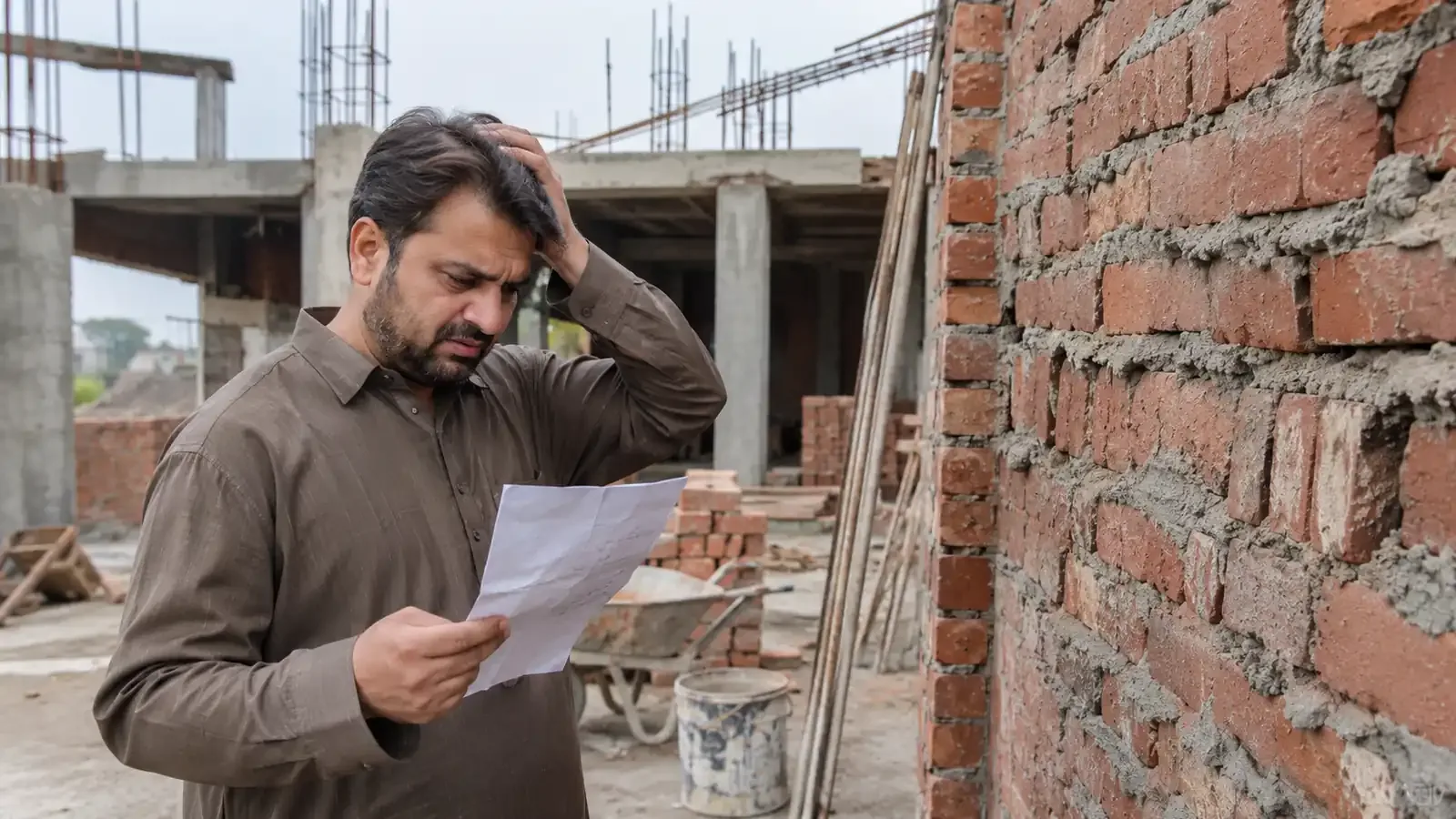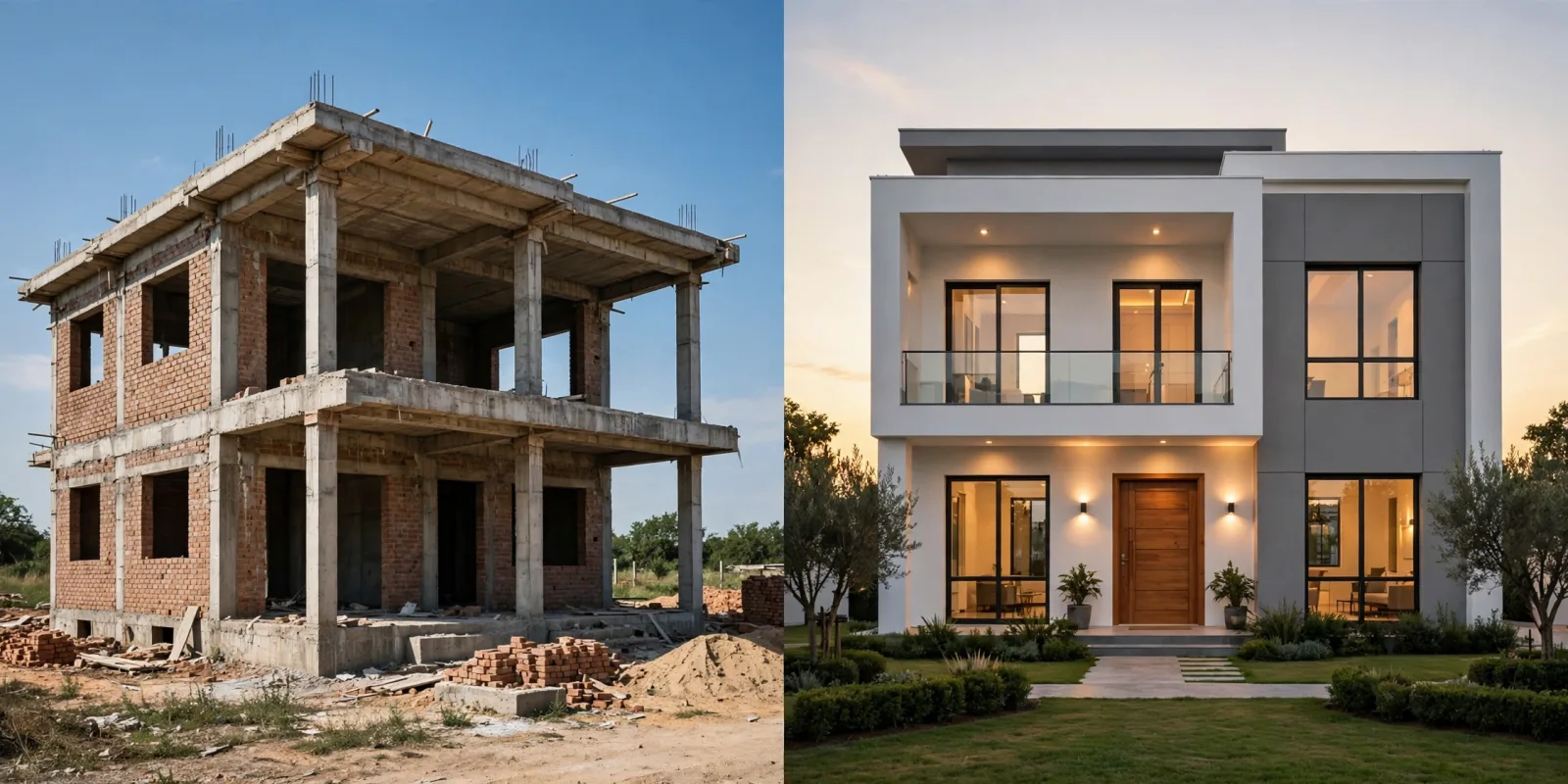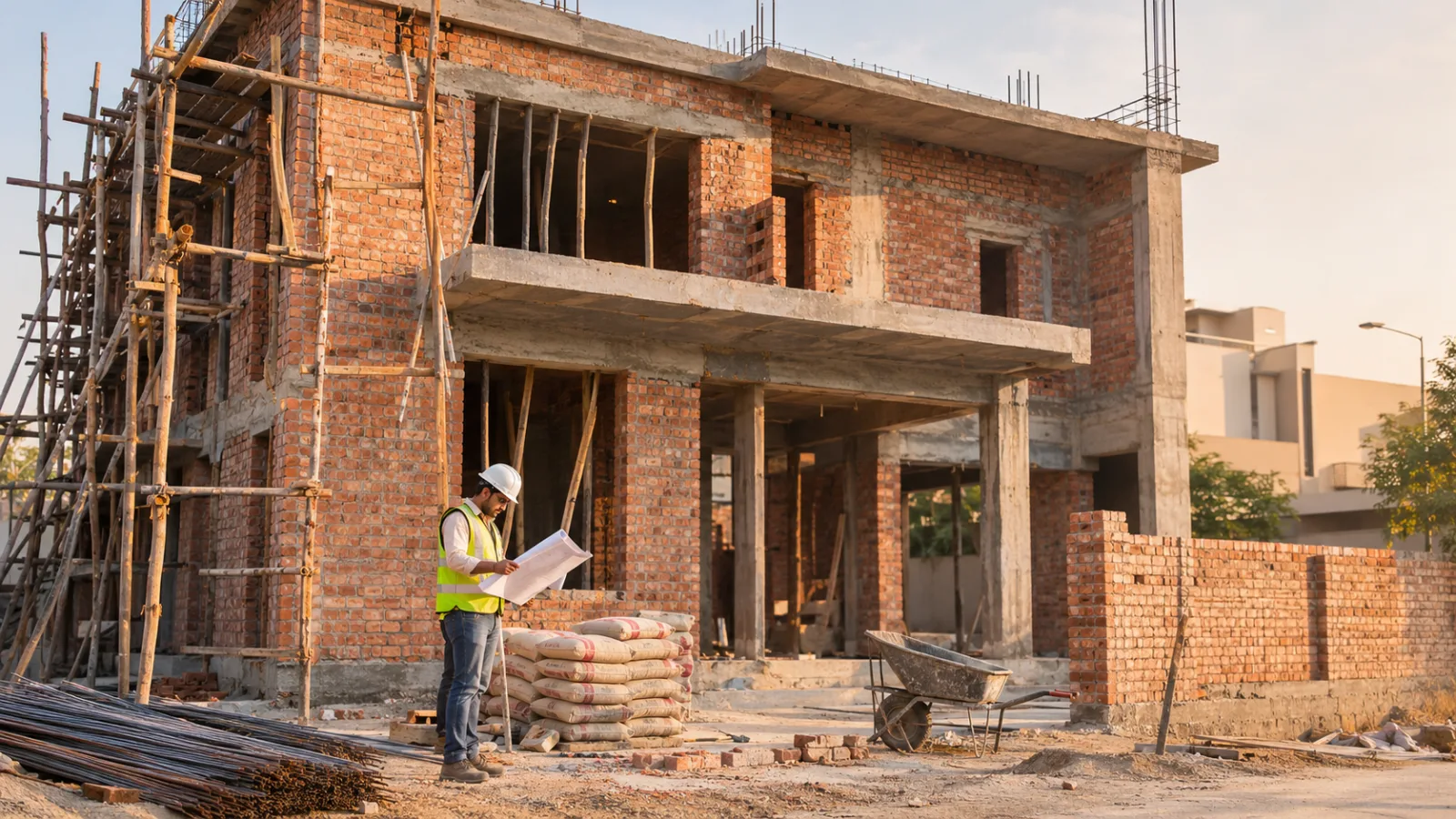
Three contractors come to see your plot. A week later you've got three quotes, and the cheapest one is PKR 12 lakh lower than the other two. Lucky find, or a warning sign? With grey structure cost in Lahore climbing through 2026, that's the question we hear most. This guide covers what the rate really is right now, why it went up this year, and how to read a quote line by line before you sign anything.
What grey structure cost in Lahore looks like right now
Let's start with the number everyone wants. Across the published 2026 rate guides, the grey structure cost in Lahore for a standard A-grade house sits roughly between PKR 2,600 and PKR 3,400 per square foot of covered area. Glorious Builders lists PKR 2,560 to 2,875 for LDA areas. Avenir Developments puts it at PKR 2,800 to 3,400 and up. Zameen's calculator showed about PKR 2,777 for a 10 marla house back in January.
Why such a wide band? Because "grey structure" isn't one product. A 5 marla house in an LDA scheme and a 1 kanal house with a basement in DHA Phase 6 are different jobs, even if both quotes say "grey structure, A-grade material."
Location matters more than people expect. DHA Lahore typically runs 15 to 20 percent above the base rate, mostly because of stricter inspections and site rules. Bahria Town is a little above base too. South Lahore societies like Lake City and Etihad Town tend to sit at the lower end.
So treat any single "rate per square foot" you see online (including ours) as a starting point. It's useful for a sanity check. It's not a price.
Why construction rates in Lahore went up in 2026
If you got a quote last year and you're getting one again now, you've probably noticed the jump. It isn't contractors getting greedy. Mostly it's materials.
Cement is the clearest example. In early February 2026, a 50 kg bag in Lahore was selling for about PKR 1,390 to 1,480. By August, the Pakistan Bureau of Statistics weekly average for northern Pakistan had reached around PKR 1,567. In early November, market reports still had premium brands like Maple Leaf near PKR 1,570 a bag. That's roughly a 10 percent rise on one of the biggest line items in your structure.
Steel moved too. Grade 60 sariya was quoted around PKR 230 a kilo in January. By mid year, mill rates were being reported near PKR 277 a kilo. Prices for both have been unstable all year, largely because fuel prices swung so hard after the Iran conflict pushed oil up. Cement plants run on energy, and every bag and bundle of steel reaches your site on a diesel truck.
What does that mean for you? Two things. First, a quote from six months ago is probably out of date. Second, the clause about who pays if material prices rise mid project matters more than ever. More on that below.
Note: material prices change week to week. Please check today's cement and steel rates with a dealer before you finalise a budget.
What a grey structure quote should include (and what it often doesn't)
This is where most of the gap between quotes comes from. Two contractors can both write "grey structure" and mean very different things.
Usually included
- Excavation, foundation and DPC (damp proof course)
- RCC work: columns, beams, slabs and the roof (lanter)
- Brick masonry for outer and inner walls
- Plaster, inside and out
- Conduits for electrical wiring and pipes for plumbing, laid inside walls and slabs
- Labour for all of the above
Often left out, so ask
- Basement excavation, retaining walls and waterproofing
- Boundary wall and the main gate
- Termite proofing before the floor goes down
- Map approval fees and society charges
- Water and electricity used on site during construction
- A qualified site engineer, not just a munshi
- Material testing, such as concrete cube tests
Here's the honest truth: a quote that looks PKR 10 lakh cheaper usually isn't cheaper. It's shorter. The missing items show up later as "extras," right when you can't easily switch contractors.
Per square foot or per marla? The mistake that costs lakhs
Grey structure cost in Lahore is almost always quoted per covered square foot. That means the total floor area of every storey added together, not the size of your plot.
Take a 10 marla double storey house. The plot is about 2,250 square feet, but the covered area is usually somewhere around 3,200 square feet once you add both floors and the mumty. Here's how the maths works:
- 3,200 sq ft × PKR 2,700 = about PKR 86 lakh
- 3,200 sq ft × PKR 3,200 = about PKR 1.02 crore
That PKR 500 per square foot difference is worth around PKR 16 lakh on one house. Now imagine one contractor measured the covered area as 2,900 square feet and another as 3,300. You'd be comparing quotes that aren't even for the same building.
So before you compare anything, ask every contractor the same question: what covered area did you calculate, and how? If the answers don't match, that's your first conversation.
Six questions to ask before you sign a grey structure contract
You don't need to be an engineer to protect yourself. You just need answers in writing.
1. Which cement and steel brands, exactly? "A-grade material" means nothing on paper. Ask for brand names and the steel grade (Grade 60 for structural work is the norm now). If it isn't written, it isn't promised.
2. What happens if material prices rise? This year has shown how fast cement and sariya can move. Some contracts lock the rate. Others pass increases on to you. Neither is wrong, but you should know which one you're signing.
3. How are payments split? Stage payments tied to real milestones (foundation, ground floor slab, first floor slab, plaster) are healthier than big advances. Be careful with anyone asking for 40 or 50 percent up front.
4. Who supervises the site day to day? A qualified engineer catching a problem in the steel before the slab is poured saves far more than they cost. Once concrete sets, mistakes are permanent.
5. Will concrete be tested? Cube tests on slabs are a simple way to check the mix was right. A contractor who welcomes testing usually has nothing to hide.
6. What's the timeline, and what if it slips? A typical double storey grey structure takes a few months without a basement. Ask for a schedule and what happens if it overruns.
Being registered with the Pakistan Engineering Council (PEC) is also worth checking, especially for bigger projects. Saiban Builders, for example, is PEC registered in the C4 category, and you can ask any contractor for their registration details the same way.
Building in Lahore while you live in Riyadh, Dubai or Doha
If you're overseas, every question above matters twice as much. You can't drop by the site on a Friday to see whether the columns look right.
We hear the same worries again and again. Will the contractor cut corners because I'm not there? Is the money I send going into my house? Should a relative handle it? Those are fair concerns, and a lot of people on property forums have shared stories about learning that lesson the hard way.
A few things make a real difference when you're building from abroad:
- Weekly photo and video updates, ideally showing steel before every pour, not just finished walls
- Payments only after a milestone is confirmed, with photos and a short written note
- An independent check at the critical stages: foundation, each slab and plaster
- A BOQ (bill of quantities) you can read, so you know what's being bought, not just a total
If a family member is helping, that's great. But give them a checklist. Love doesn't make someone a site engineer.
This is the kind of transparency we try to build into all our housing projects at Saiban Builders. It comes from the Saiban Group's decades of working with overseas clients who needed proof, not promises.
So what should you actually budget?
Here's a practical way to think about it. Take your covered area and multiply it by a realistic grey structure rate for your society. Something in the PKR 2,700 to 3,200 range is sensible for most standard Lahore projects this year. Then add 8 to 10 percent on top for the things that sit outside a grey structure quote and for price movement. That cushion is what keeps a project from stalling halfway.
And if a quote comes in far below that range, don't celebrate yet. Ask what's missing.
If you'd like help making sense of a quote or a BOQ, our team at Saiban Builders is happy to look at it with you. You can request a quote or simply get in touch. Ask us the same six questions. We'd rather you compare properly than sign quickly.
Frequently Asked Questions
What is the grey structure cost per square foot in Lahore in 2026?
Most published 2026 guides put standard A-grade grey structure in Lahore between roughly PKR 2,600 and PKR 3,400 per covered square foot. DHA Lahore is usually 15 to 20 percent higher than LDA areas. Material prices moved a lot this year, so always confirm with a current quote.
How much does a 10 marla grey structure cost in Lahore?
A 10 marla double storey house usually has around 3,200 square feet of covered area. At PKR 2,700 to 3,200 per square foot, that's roughly PKR 86 lakh to PKR 1.02 crore for the grey structure alone, before finishing, approvals or a basement.
Is grey structure rate charged on plot size or covered area?
Covered area. That's the total floor area of all storeys combined, not the plot size. Mixing the two up is the most common reason people compare quotes that aren't really comparable.
Why did construction costs in Lahore increase in 2026?
Mainly materials and fuel. Cement in Lahore rose from roughly PKR 1,400 a bag in February to around PKR 1,550 or more later in the year, and steel prices climbed too. Higher diesel prices also pushed up transport costs for everything delivered to site.
Can I build a house in Lahore while living in Saudi Arabia or the UAE?
Yes, many overseas Pakistanis do. The key is stage-wise payments, regular photo and video updates, a clear BOQ and independent checks at critical stages. Saiban Builders works with clients who aren't in Pakistan and can walk you through how progress and payments are reported.
How do I know if a construction quote is too low?
Check what's left out. Low quotes often skip basement work, boundary walls, termite proofing, approvals, site supervision or testing. Ask for brand names in writing and a clear covered area figure. If a quote is far below the current market range, something is usually missing.